Enzo Is Injured by a Car
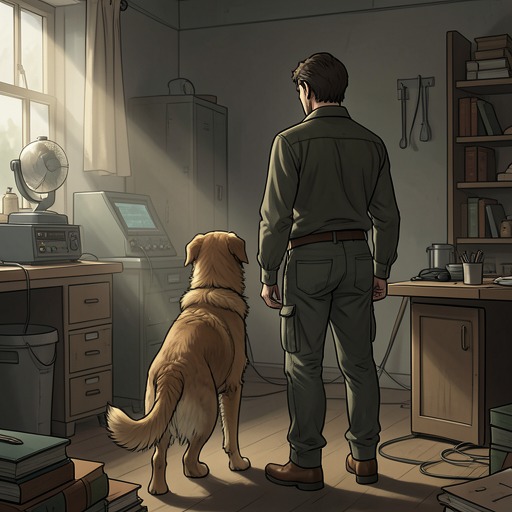
The Art of Racing in the RainEnzo Is Injured by a Car is the accident that makes Enzo’s aging body impossible to treat as an abstraction: after a nighttime walk in unexpected snow, he is hit by a car and diagnosed with a fractured pelvis, hip dysplasia, and chronic arthritis. The scene is narrated from his limited, first-person perspective, but its consequences are measured through practical acts of care: Denny lifts him, finds a ride, and takes him for treatment, where the cost and diagnosis make the injury’s seriousness concrete.
Causes and Setting
The accident occurs after Enzo and Denny extend one of their usual short walks from Volunteer Park. The weather is unusual for Seattle: snow falls in a city Enzo associates with rain, and he notices a thin covering gathering on the pavement. The change in conditions unsettles him, while the empty street ahead creates a particular opening for a lapse in attention. The narrative does not present the snowfall as a dramatic storm; its importance lies in how an unfamiliar surface changes the ordinary walk. Denny often lets Enzo walk home without a leash. On this night, Enzo strays farther than usual, watching the flakes gather along Tenth Avenue, which has no cars or people in view. Denny is across Aloha and calls and whistles for him. Enzo looks up, realizes that Denny has crossed without his noticing, and experiences the space between them as more than the width of a road. When Denny beckons, Enzo runs toward him. Denny’s warning comes just before the collision, but the car reaches Enzo on the snow-covered street. The sequence turns on a small but consequential misreading: Enzo is focused on Denny and responds to the call by bounding across, while the quiet street and snow obscure the danger of the approaching vehicle. Enzo’s own narration immediately assigns blame to himself, interpreting the collision as evidence of his stupidity. That judgment belongs to his distressed perspective; it is not a clinical explanation of the accident. The scene instead makes clear how quickly an ordinary act of reunion can become a physical emergency.
The Collision and Immediate Response
The snow changes the sound of the event. Enzo recalls that the tires do not make the scream he associates with tires; their sound is hushed by the thin layer of snow, and then the car hits him. The detail matters because it marks the instant when the familiar street ceases to be a safe route home. The narration stays close to Enzo’s perception and confusion rather than giving an external account of the driver’s actions or assigning fault. Denny lifts Enzo and holds him. A person nearby offers help, and Denny asks for a ride because he is several blocks from home and cannot carry Enzo that far. The driver is a teenager who has witnessed what happened. Rather than dwelling on blame, Denny directs attention to what needs to happen next and asks the boy to drive. He sits in the back with Enzo on his lap and reassures him during the trip. The immediate response thus changes the scene from a sudden accident into an instance of coordinated care: Denny accepts help, keeps Enzo close, and concentrates on getting him to a clinic. That response fits a wider pattern in Denny’s life. He has taken on substantial household and childcare responsibilities to reduce the burdens on Eve, and he has trusted Enzo to stay beside and comfort her when he and Zoë have to leave. The collision reverses that arrangement for a time. Enzo, usually a companion within the family’s routines, is now dependent on Denny’s physical support and decisions. The scene gives that dependence a specific form without suggesting that care removes the strain or cost of the emergency.
Diagnosis and Cost
At the veterinary clinic, Enzo remembers separate entrances for cats and dogs, as well as another entrance for infectious animals. His account registers the clinic through the categories and procedures he can perceive. The doctor manipulates his hips, gives him a shot, and Enzo falls asleep. When he wakes, he is groggy and no longer in pain. Snatches of medical discussion reveal the diagnosis: hip dysplasia, chronic arthritis, and a nondisplaced fracture of the pelvic bone. The fracture is new, but the other conditions locate the accident within a longer history of bodily deterioration. The clinic’s list of interventions includes an examination, X-rays, a sedative, a cortisone injection, and pain medication. The bill is eight hundred twelve dollars, a concrete consequence that Denny meets by handing over a credit card. The amount makes the cost of treatment part of the event rather than an invisible backdrop. It also places the emergency within the family’s wider financial pressures, without turning the treatment into a claim that money alone resolves Enzo’s condition. Denny tells Enzo that his pelvis is cracked, that it will heal, and that he must take it easy for a while. His reassurance offers a near-term course of recovery, but the medical terms Enzo has overheard complicate the promise of being good as new: dysplasia and chronic arthritis are not the same as the acute fracture. The encounter therefore holds reassurance and limitation together. Enzo is no longer in pain after treatment, yet the diagnosis names an aging body whose vulnerabilities extend beyond the collision.
Narrative Meaning and Aftermath
The accident shifts Enzo from observer and household companion into the role of the injured animal who must be carried. That change sharpens the book’s attention to dependence: Denny’s care is expressed not as a general sentiment but through lifting Enzo, arranging transportation, staying with him, and paying for treatment. Enzo’s narration, meanwhile, registers the event through his own self-reproach and his incomplete understanding of the human and medical world. Readers can distinguish his immediate conclusion that he is stupid from the facts the scene establishes about the weather, the crossing, and the injury. The collision also belongs to a recurring pattern in which Enzo interprets images and events through his longing for fuller participation in human life. Elsewhere, he connects his outlook to the idea that what one manifests lies before oneself; that reflection frames his approach to the car, but does not make the accident a deliberate act or erase its contingent circumstances. Later, when a sliding zebra appears on a souvenir pen, Enzo revises his earlier belief in an external demon, understanding the zebra as an image of fear and self-destructive impulses. That later interpretation gives the accident’s self-blaming narration a useful counterpoint: Enzo’s explanations may be emotionally revealing without being complete accounts of what happened. The event’s decisive consequence is thus both medical and relational. Enzo sustains a pelvic fracture against a background of chronic joint disease, while Denny’s response demonstrates how care continues under pressure, in the middle of an unexpected night emergency. The snow-covered crossing makes vulnerability visible; the clinic, its diagnosis, and its bill carry that vulnerability into the family’s practical life.